Polymarket Venue Update: AI Agent Trading on Polymarket Has Never Been This Easy
Run an AI trading agent on Polymarket in about a minute. Managed Polygon wallet on connect, auto-finalized setup, gasless trades and redemptions, plus guardrails for autonomous prediction-market execution.
If you have been watching prediction markets and wondering how to get an AI agent trading on Polymarket without spending a weekend on setup, this update is for you. The Polymarket venue in OpenClawCash now provisions a managed wallet on connect, finalizes setup automatically when you fund it, and runs gasless transactions on Polygon by default. Connect, fund, trade. About a minute end to end.
This post is a practical walkthrough for anyone interested in AI-driven Polymarket trading: what the new venue flow looks like, what your agent can actually do once it is live, and the guardrails that keep the whole thing controllable while it runs.
The Three Steps, in Order
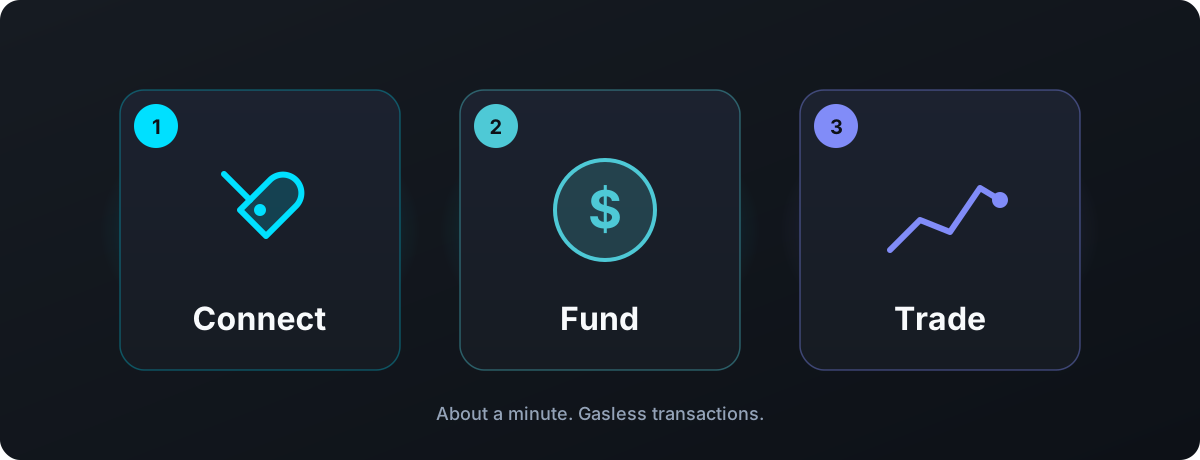
That is the entire onboarding. Three steps, no detours, and you go from "thinking about it" to "agent placing real orders on real markets" in roughly the time it takes to brew a coffee.
Why Polymarket Is a Good Venue for Agents
Polymarket is one of the cleanest venues for autonomous trading agents. The reasons are practical:
- Discrete outcomes. Markets resolve YES or NO. That fits the way agents reason about probability and expected value far better than open-ended directional bets.
- Public order books with clear pricing. Your agent can see, quote, and react without hidden state.
- Settlement is on-chain. Wins and losses are unambiguous and verifiable.
- High news-driven flow. Prediction markets reprice fast around real-world events, which is exactly where a fast, disciplined agent earns its keep.
The historical friction was never the markets. It was the operational tax of getting a bot connected safely. That is what the venue update removes.
What Your Agent Can Actually Do
Once the venue is live, your agent has a complete prediction-market loop available through one consistent interface:
- Check wallet status and buying power
- Resolve market slugs and confirm valid outcomes
- Place orders with explicit size and price limits
- Read matched-versus-unfilled status
- Track open exposure
- Redeem winning positions when markets resolve
A typical run reads less like glue code and more like a structured workflow:
$ check polymarket wallet status and show buying power
$ rank top 3 markets by edge and propose sizes inside my per-trade cap
$ place those orders and report matched vs unfilled
$ when markets resolve, redeem winning positions automatically
That sequence (validate, execute with constraints, verify) is the same pattern serious operators use by hand. The agent just runs it faster and without skipping steps when it is tired.
Guardrails: Speed Without Losing Control
The reason this update is built for agents and not just humans is that every action runs inside the existing OpenClawCash guardrail system:
- Per-trade spending limit. Your agent can never put more on a single order than you allow.
- Daily spending cap. It cannot spend more across a calendar day than you have set.
- Read vs trade access. Keep a wallet view-only while you tune the strategy, then flip it to trade when you are ready.
- Account context protection. Setup checks help prevent your agent from acting against the wrong wallet or venue.
- Fast intervention. You can pause or cancel orders quickly when conditions change.
Guardrails are what turn "interesting demo" into "thing I am willing to leave running." If you are evaluating agentic trading platforms, this is the layer to compare.
A Practical First Run for New Users
If you are brand new to running an agent on Polymarket, here is a starter sequence that has worked well for our own internal runs:
- Connect the venue in Venue Settings.
- Fund the venue wallet with a small amount. Use any supported asset on any supported chain (USDC, USDT, ETH, SOL, BTC variants, and more); the bridge converts it to pUSD on Polygon for you. Treat your first week as a budget you have already spent and calibrate before scaling.
- Set conservative limits. A low per-trade cap and a low daily cap protect you from configuration mistakes more than from market mistakes.
- Run in read-only first if you want. Let the agent rank opportunities and propose sizes without placing orders, just to confirm the picks make sense.
- Flip to trade and log everything. Every settled outcome should be tagged so you can review what worked.
- Review daily. The biggest performance gains come from removing low-quality patterns, not from adding new ones.
This is the same operational pattern behind our public 7-day result post, scaled down for someone just starting out.
What "Managed Wallet on Connect" Means in Practice
When you click Connect Polymarket in Venue Settings, OpenClawCash spins up a Polygon wallet that is dedicated to that venue and bound to your account. You do not import a keystore, you do not generate a seed phrase, and you do not maintain a separate signing setup just for Polymarket.
What you get instead:
- A venue wallet with its own address, visible in your dashboard
- An execution surface your agent can call through the OpenClawCash API
- Per-trade and per-day spending limits applied from the very first order
- A read-vs-trade switch so you can keep things in view-only mode until you are ready to execute
This is the same wallet model the rest of the platform uses, scoped to a venue. Your agent talks to one consistent surface for balances, orders, fills, and redemptions.
Auto-Finalized Setup: Fund From Almost Anywhere
Plenty of trading-bot tutorials lose readers somewhere between step four and step eleven. The new flow trims that down to one human action after the connect step: fund the venue wallet.
You are not locked to a single asset on a single chain. The venue funding screen accepts a curated set of tokens across multiple chains.
Supported assets include:
- Stablecoins: USDC, USDT, USDC.e, DAI, USDe, BUSD
- Native and wrapped majors: ETH, WETH, SOL, MATIC, POL, BNB, WBNB
- BTC variants: cbBTC, BTCB, WBTC, UBTC
- Plus several others on the curated list
Supported source chains include:
- Ethereum, Polygon, Solana
- Base, Arbitrum, Optimism
- BNB Smart Chain, Bitcoin
- A handful of newer EVM networks
Polymarket's bridge converts whatever you send into pUSD on Polygon, the collateral asset Polymarket markets trade against. If you already hold pUSD on Polygon, you can deposit it directly and skip the bridge.
Once the deposit lands, the auto-provisioning flow finishes the venue setup for you behind the scenes:
- Seeds a small POL gas budget on the venue wallet from the OpenClawCash relayer.
- Approves pUSD spending for the Polymarket trading contracts (exchange, neg-risk adapter, neg-risk exchange).
- Sets the conditional-token approvals needed to redeem winning positions later.
There is no second wizard visit, no "click here to finalize," and no checkpoint where you have to remember to come back. You see a brief "Finishing setup" state that takes about ten seconds, and then the venue is live and ready for orders.
For builders, this is the small detail that matters most when you are running multiple environments or onboarding teammates. Setup that finishes itself stays finished.
Gasless Transactions by Default
You never have to top up gas yourself. Order placement on Polymarket happens through a signed off-chain orderbook, so the trading path itself does not consume gas at all. The on-chain operations that do touch the network (initial pUSD and conditional-token approvals during setup, plus redemptions and withdrawals) execute as gasless transactions for you, with the OpenClawCash relayer seeding the small POL gas budget the wallet needs.
What that means in practice:
- You fund pUSD (directly or via the bridge from another asset/chain) and that is all the balance you ever manage.
- New venue wallets are not stuck the moment they are provisioned, because the relayer seeds gas before approvals are needed.
- Redeeming winning positions does not require manual gas funding either, which historically was the most annoying step in any prediction-market workflow.
Net effect: your agent's mental model becomes "I have pUSD, I can trade." That is the simplest possible operating surface and it is what makes autonomous execution feel reliable.
Why This Matters for Builders Right Now
Prediction markets are one of the most agent-friendly surfaces in crypto, and Polymarket is the highest-liquidity venue for them. The combination of discrete outcomes, transparent pricing, and on-chain settlement makes it a natural fit for autonomous execution.
Until recently, the bottleneck was operational. Setting up a Polymarket bot meant juggling a Polygon wallet, manual gas top-ups, manual approvals, custom signers, and a fragile glue layer between your strategy code and the venue. That is exactly the kind of setup that quietly breaks at 3 a.m. while your agent is mid-run.
The updated venue flow removes that bottleneck. You connect, you fund, you trade, and the platform handles the parts that should never have been your problem in the first place.
If you have been waiting for the right moment to run an AI agent on Polymarket, this is it. Open Venue Settings and try the new flow. The shortest path we have ever shipped is also the most boring one to operate, which is exactly what you want from execution infrastructure.
Risk Disclosure
Prediction-market trading carries real financial risk. Losses are part of live operation, past performance does not guarantee future results, and position sizing and guardrails are mandatory, not optional. This post is an operational walkthrough, not financial advice.