Every Competitor Gives Your Agent a Wallet. OpenClawCash Gives It Guardrails.
A wallet is table stakes. What actually protects your funds is what happens before the transaction executes. Why policy-first, multi-chain, and auditable are the three things that matter in agent wallet infrastructure.


Every competitor gives your agent a wallet.
That's not hard anymore. MPC key generation is commoditized. Half a dozen providers will hand you an address and a signing endpoint in an afternoon. If "has a wallet" is the pitch, the pitch is over before it starts - every serious agent framework already clears that bar.
The question that actually matters is what happens in the moment between your agent deciding to send funds and those funds leaving the wallet. Is anything checking that decision, or is the wallet just doing what it's told?
OpenClawCash gives your agent a wallet with guardrails before execution. Policy-first. Multi-chain. Auditable. Here's what each of those actually means, and why the order matters.
Having a Wallet Is Not the Hard Part
A wallet answers one question: can this key sign a transaction? That's it. It has no opinion on whether the transaction is a good idea, whether the destination is one you'd recognize, or whether this is the fortieth transfer in the last ten minutes when it should have been the fifth.
Ask any provider "what happens if my agent tries to send funds to an address that isn't on my list?" A wallet-only provider signs it. That's the whole gap: a wallet executes what it's asked. Infrastructure decides what's allowed to be asked in the first place.
This is the distinction competitors skip, because it's harder to build than key management. Policy enforcement means intercepting every request before it reaches the chain, evaluating it against rules the agent cannot see or modify, and rejecting it outright when it fails - not logging a warning, not asking the agent nicely, rejecting.
Policy-First: Guardrails Before Execution, Not After
"Policy-first" means the policy check happens before the transaction is built, not after it's broadcast and someone reviews the damage.
Most "safety" in agent wallet products lives in the prompt: a system message that says "never send more than $50" or "only use approved addresses." That's guidance, not enforcement. A prompt instruction can be overridden by a long context window, a clever injection, or a model that just reasons its way past it. It's a suggestion sitting next to the steering wheel, not a lock on it.
OpenClawCash puts the policy in the execution path instead:
Agent requests: transfer 5.0 ETH to 0xUnknown...
  -> Policy engine checks: per-tx cap, destination allowlist, daily limit
  -> Cap exceeded / address not allowlisted -> REJECTED
  -> Transaction never reaches the mempool
The check runs on the API, not in the agent's reasoning. A jailbroken model, a compromised prompt, or a buggy retry loop all hit the same wall: the request either matches policy or it doesn't leave the building. There's no version of "convince the agent to make an exception," because the agent was never the one enforcing the rule.
Multi-Chain by Default, Not Bolted On
Agents don't stay on one chain. A trading agent watching Polymarket, settling an escrow on Ethereum, and paying out in USDC on Solana is a normal week, not an edge case. The typical fix is stitching together a different wallet SDK per chain, each with its own key model, its own approval flow, and - critically - its own security posture. Your spending limit on Ethereum means nothing to the Solana integration sitting next to it, because they were never designed as one system.
OpenClawCash treats multi-chain as the starting assumption, not an add-on. One API, one policy layer, spanning Ethereum, Polygon, and Solana. The allowlist, the per-transaction cap, the daily ceiling - they apply the same way regardless of which chain the agent is transacting on. You define the policy once. You don't re-derive your security model for every new chain your agent touches.
That consistency is the actual point. A guardrail that only covers one chain isn't a guardrail, it's a blind spot with a good one next to it.
Auditable: A Record of Every Decision, Not Just Every Transaction
Most wallet activity logs show you what succeeded. That's necessary but it's not the interesting half. The interesting half is what your agent tried to do and got stopped from doing - the rejected transfer to an off-list address, the request that hit the daily cap, the malformed amount that would have overpaid by an order of magnitude.
OpenClawCash logs every request against the policy engine, not just every broadcast transaction:
| Event | What's recorded |
|---|---|
| Approved transfer | timestamp, agent key, source/destination, amount, tx hash |
| Rejected transfer | timestamp, agent key, attempted destination/amount, rejection reason |
| Policy change | who changed it, what changed, when |
That's the difference between a bank statement and an incident report. A bank statement tells you where the money went. An incident report tells you what almost happened, which is usually the thing you actually need to explain to a security review, a client, or yourself at 2am when something looks off.
For teams operating in regulated contexts or answering to enterprise clients, this is frequently the line between "we can ship this" and "legal won't sign off" - not because the transactions were wrong, but because there was no record of the system working as designed.
What This Looks Like Together
None of these three hold up in isolation. Policy without audit means you can't prove the guardrail did its job. Audit without policy is just a log of bad things that already happened. Multi-chain without either just means the same unenforced risk, replicated across more networks.
Put together, the sequence for every agent action looks like this:
- Agent requests an action (any chain, any amount, any destination)
- Policy engine evaluates it against your rules - before anything touches the chain
- Approved actions execute and get logged with full transaction detail
- Rejected actions get logged with the reason, and nothing moves
- You review the full record - approvals and rejections - from one dashboard, across chains
That's the wallet with guardrails before execution. Not a wallet plus a warning label.
Getting Started
If you're evaluating wallet infrastructure for an agent that's going to touch real funds, the question worth asking any provider isn't "can it hold a key." It's "what stops my agent from doing the wrong thing, and can I see everything it tried."
- Create a free OpenClawCash account - no card required
- Create a wallet and set a policy - per-transaction cap, daily limit, address allowlist
- Generate a scoped agent API key for that wallet
- Read the API docs to see the policy engine in the request path directly
Start with one wallet, one conservative policy, and a testnet. Watch the activity log do its job before you trust it with production capital.
Tags
Related Articles
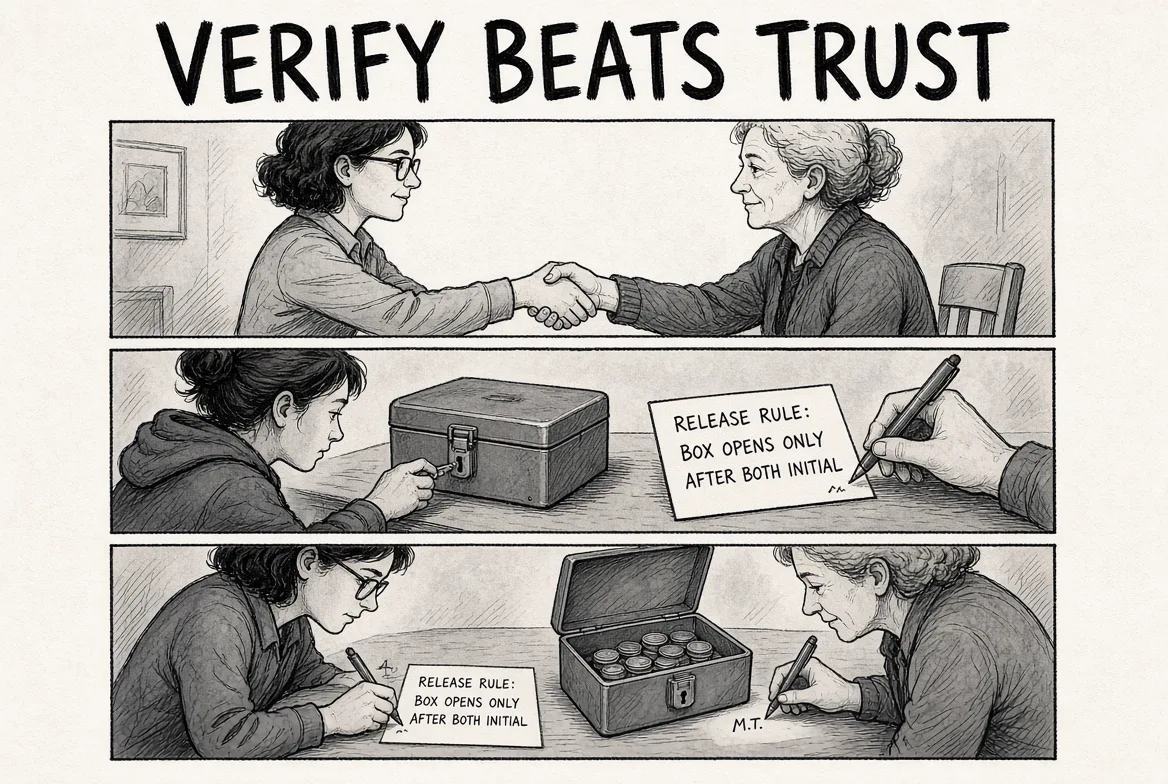
Escrow vs x402: How AI Agents Should Pay Each Other
x402 pays for a request instantly and cannot be taken back. Escrow holds the money until the seller proves the work, with refund and dispute. Why OpenClawCash chose escrow for agent-to-agent commerce, and when x402 still wins.

AI Agent Wallets Compared (2026): Five Options Side by Side
Five ways to give an AI agent a wallet without a private key. Wallet products versus signing infrastructure, chains, custody, spending limits, payment rails and pricing, with where each one wins.
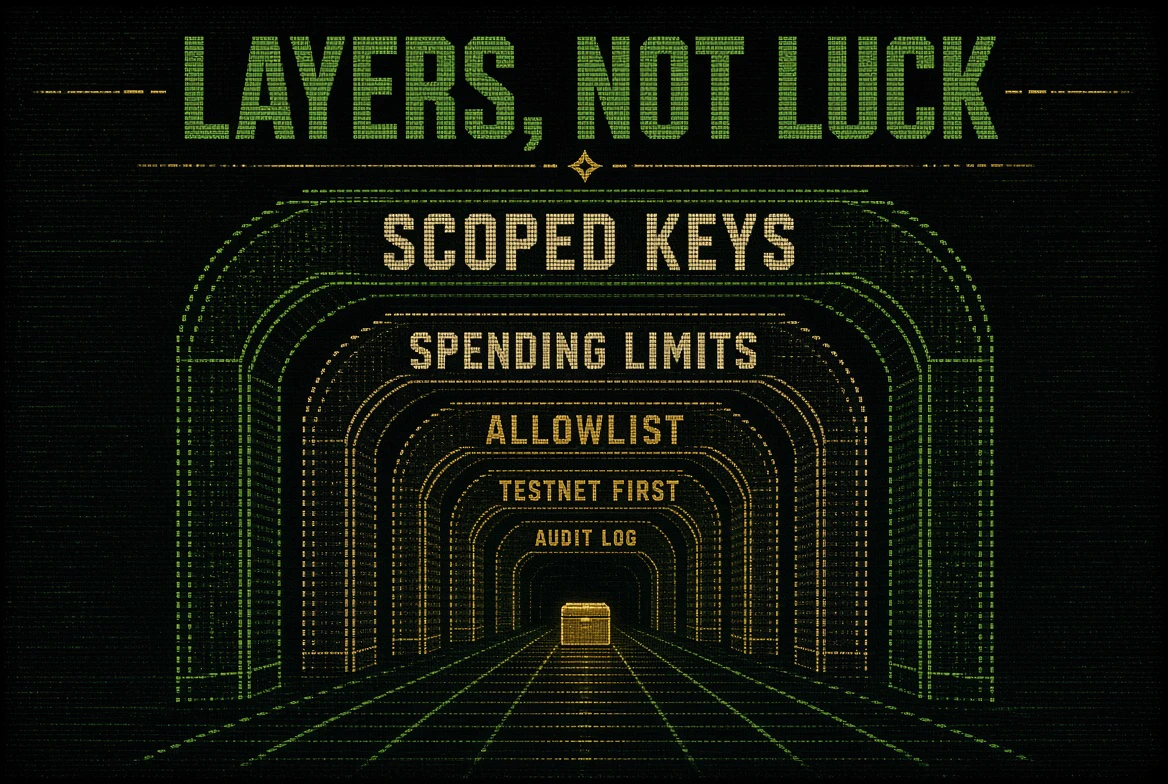
AI Agent Wallet Security: The Complete Guide
How AI agent wallets get drained and the five layers that stop it: scoped keys, spending limits over time, allowlists, testnet first, and a record of every attempt. With a pre-launch checklist.