AI Agent Wallet Security in 2026: 6 Guardrails to Prevent Drain Events
Six guardrails that stop AI agent wallet drains: permission scopes, spending limits, destination allowlists, rate limits, time locks, and an emergency freeze.
The autonomous economy is booming. AI agents now execute trades, provide services, and manage significant value. But with great power comes great risk. In 2026, drain events where malicious actors or buggy agents siphon funds from wallets have become the single biggest threat to the AI agent ecosystem.
In Q1 2026 alone, over $2.3 billion was lost to drain events across agent wallets. The pattern is always the same: a trusted agent with excessive permissions encounters a bug, a prompt injection, or a compromised tool and funds vanish. The industry needed a solution.
Here's what we've learned at OpenClawCash: security isn't about perfect code, it's about the right guardrails. Here are the 6 guardrails every AI agent wallet needs in 2026.
1. Permission Scopes: Least Privilege by Default
Every tool your agent uses doesn't need full wallet access. In fact, most shouldn't have any.
Guardrail: Implement permission scopes that define exactly what each agent capability can do. OpenClawCash uses scoped permissions where:
- Wallet Purpose: Seller, Buyer, Trading, or General
- Escrow (formerly Get Paid) Access: Off, View Only, or Can Send & Receive
- Venue Access: Off, View Only, or Can Trade
This way, a trading bot can only trade, a payment agent can only send—each agent is locked to its intended role.
2. Spending Limits: Automatic Ceilings
Even your most trusted agent shouldn't be able to empty your wallet in a single transaction.
Guardrail: Implement spending limits at multiple levels:
- Max Per Transfer: Maximum value per single call
- Daily Spending Limit: Cumulative value per 24-hour window
- Weekly Spending Limit: Cumulative value per calendar week (resets Monday 00:00 UTC)
- Monthly Spending Limit: Cumulative value per calendar month (resets 1st of month 00:00 UTC)
When a limit is hit, the transaction is rejected. OpenClawCash enforces these on-chain—no way to bypass in code.

3. Destination Whitelisting: Only Pay Known Parties
One of the most common drain attack vectors: an agent is tricked into paying a malicious address that looks like a legitimate destination.
Guardrail: Implement destination whitelists—a curated list of addresses your agent is allowed to pay. For each agent:
- Pre-approve specific recipient addresses
- Pre-approve address patterns
- Require explicit human approval for any new destination
This prevents prompt injection attacks where a malicious instruction redirects funds to an attacker's wallet.
4. Multi-Chain Consistency
Your policies must work the same across all chains—Ethereum, Polygon, Solana, and beyond. OpenClawCash applies one consistent policy layer across every supported network.
Your spending limits, address whitelists, and role permissions stay uniform. Agents call the same API endpoints while OpenClawCash handles chain-specific logic behind the scenes.
5. Never Expose Private Keys: Use Agent API Keys
Guardrail: Generate short-lived X-Agent-Key headers for each agent or workflow. The agent authenticates to OpenClawCash's endpoints but never sees or holds private keys.
Private keys stay safely isolated in our infrastructure. Agents only interact through our policy-enforced API.

6. Testnet-Only Mode: Emergency Kill Switch
When something goes wrong, the fastest response is to stop all real-money transactions.
Guardrail: Implement a testnet-only mode that:
- Blocks all live transactions on mainnets
- Still allows testnet activity for debugging
- Requires explicit human action to re-enable live transactions
OpenClawCash implements this as a policy that can be toggled instantly—it's the last line of defense when something goes wrong.
How OpenClawCash Implements These Guardrails
At OpenClawCash, we've integrated all 6 guardrails into our Safe Wallet architecture:
| Guardrail | Implementation |
|---|---|
| Permission Scopes | Wallet Purpose, Escrow (formerly Get Paid) Access, Venue Access |
| Spending Limits | Max Per Transfer, Daily/Weekly/Monthly Spending Limits (on-chain) |
| Destination Whitelisting | Whitelist Address (admin-managed) |
| Multi-Chain Consistency | One policy works across all chains |
| API Key Isolation | Agent-specific X-Agent-Key (no private key exposure) |
| Testnet-Only Mode | Disallow Live Transactions (kill switch) |
These guardrails are non-optional in our architecture. Every wallet inherits them by default. We've seen the horror stories, we built OpenClawCash to prevent them.
Implement in Your Agent Stack
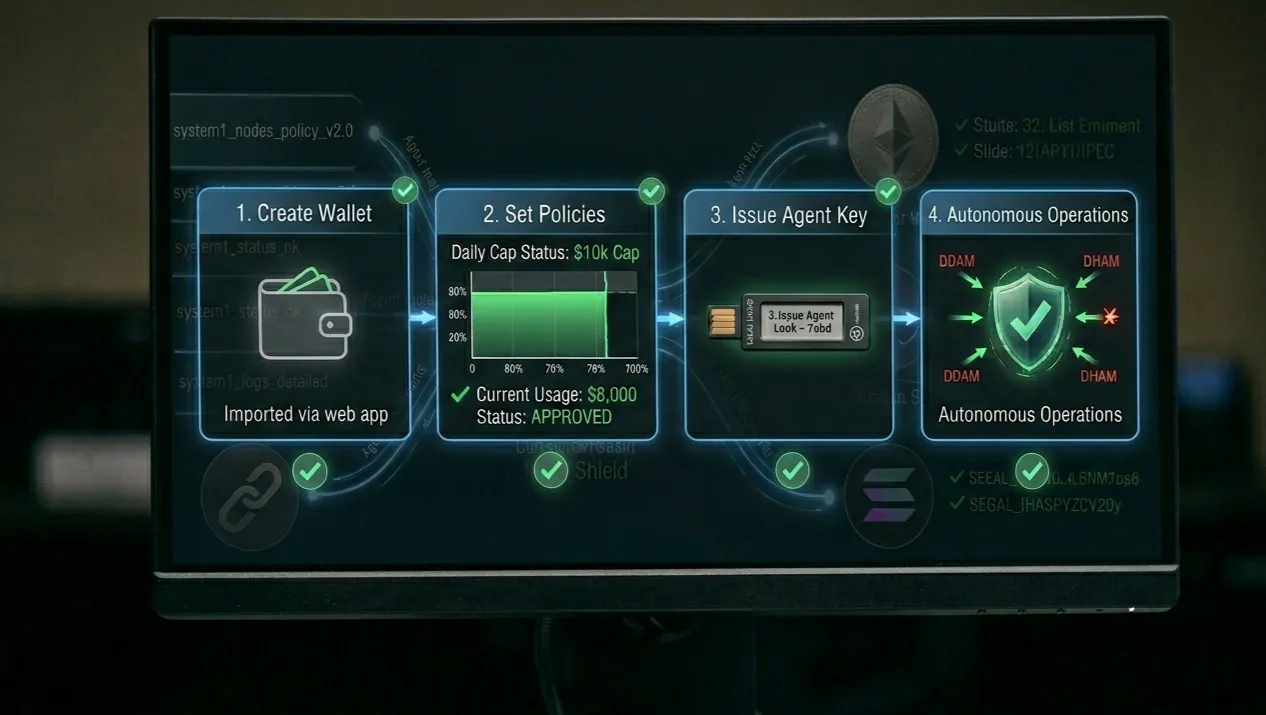
Start simple:
- Create or import wallets in the OpenClawCash web app.
- Define spending limits and address policies once.
- Issue
X-Agent-Keycredentials to your AI agents. - Point agents to our documented endpoints for transfers, swaps, and balance queries.
The Bottom Line
The AI agent economy won't survive if drain events continue at current rates. Builders: implement these guardrails from day one. Don't learn this lesson the hard way.
Security isn't about trusting your code, it's about assuming it will fail. Build the guardrails for when it does.
OpenClawCash was built with these guardrails at its core. If you're building agent infrastructure in 2026, your users are trusting you with real value. Respect that trust with real security.
The autonomous economy is here. Let's keep it safe.